
Playlists overview
Static playlists appear under Library > Playlists. Flows appear separately under Flows because their downloaded media is temporary.
Aurral does not write these files to your main music library.
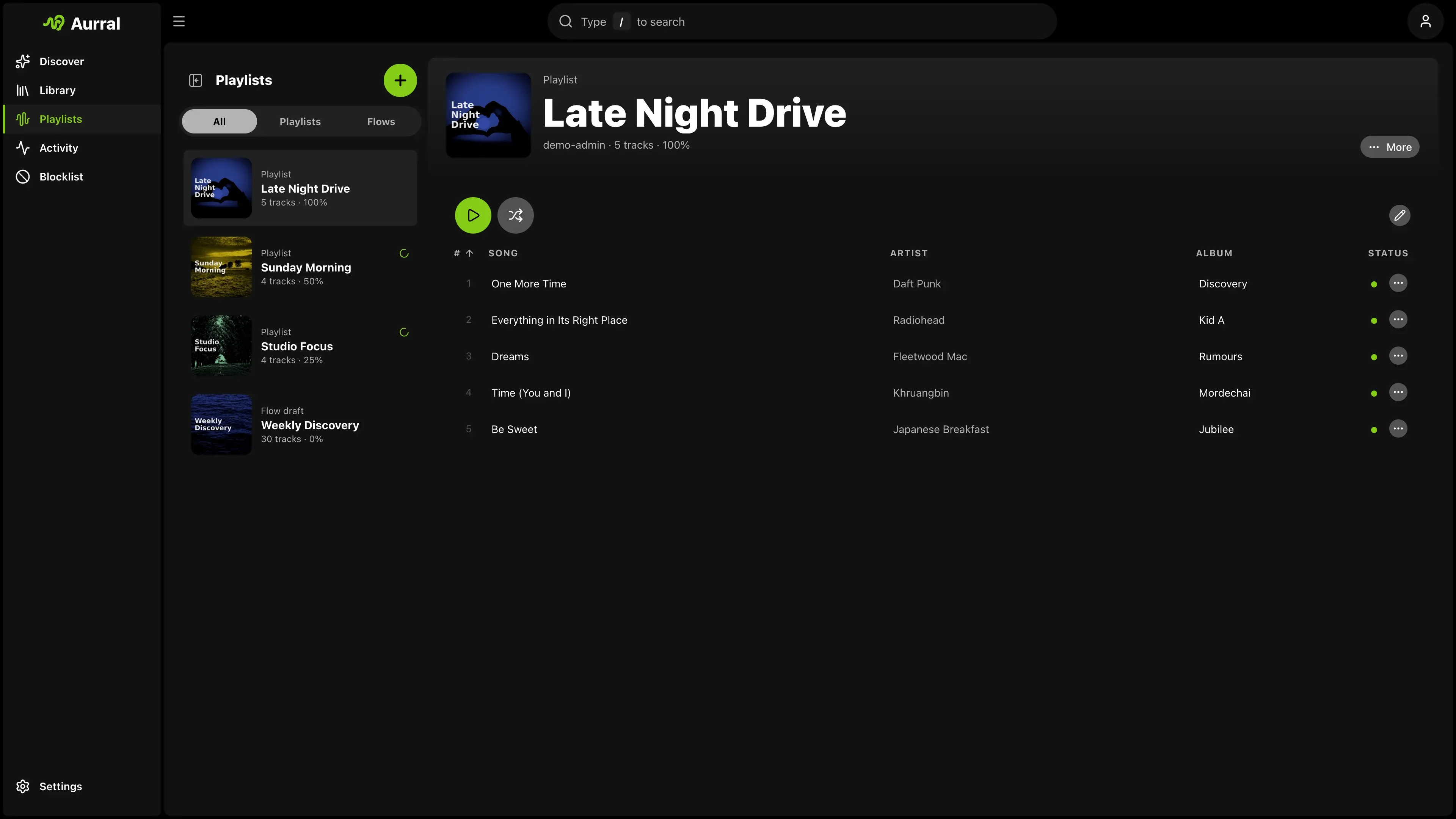
Flows compared with static playlists
Section titled “Flows compared with static playlists”| Flows | Static playlists | |
|---|---|---|
| Tracklist | Regenerates on a schedule | Fixed from import or follows a provider |
| Downloads | Can generate replacement picks | Keeps the exact imported tracks |
| Controls | Schedule, source mix, focus, deep dive | Import, sync, and retention settings |
| Worker | Shared download worker | Shared download worker |
Flows refresh on a schedule and use your flow settings. Static playlists come from Spotify, Last.fm, ListenBrainz, JSON files, or exported flow tracklists. Synced imports follow provider membership; their removed-track file-retention setting is available in the import flow and playlist menu.
Flow names and static playlist names must be unique across both types. Aurral uses the same bare name for Navidrome and Plex playlists.
If all download sources fail, the track stays in the failed state after an Aurral restart.
Select Re-search missing from the playlist menu to try the track again.
Import and Lidarr sync
Section titled “Import and Lidarr sync”Use Import playlist for Spotify, Last.fm, ListenBrainz, or a JSON tracklist. Connect Spotify in the import flow. Connect ListenBrainz in Settings > Playback; configure a Last.fm username in Profile. See Playlist imports.
Flows can expose a Lidarr import URL so Lidarr polls the current flow tracklist as a custom import list. See Lidarr: Import list feeds.
Where files go
Section titled “Where files go”Static playlist membership is stored as canonical track references. Aurral-owned
permanent tracks use the canonical artist/album/track layout under the
configured Aurral download folder. Set this path in Settings > Download clients.
Flow media is temporary and lives under _flows below that root. Navidrome and
Plex can use the roots they are configured to scan.
See Navidrome and Plex for playback setup.
See yt-dlp, slskd, and Usenet for download setup.
See Filesystem and mounts for storage setup.
Quality profile
Section titled “Quality profile”Open Settings > Download clients > Quality profile to set the audio quality rules for flows and static playlists.
The profile is global. Only an administrator can change it.
The list order sets the quality rank. Move the best quality to the top. Select each tier that Aurral can accept. Select one enabled tier as the cutoff.
- An enabled tier at or above the cutoff is Preferred.
- An enabled tier below the cutoff is Upgrade.
- A disabled or unknown tier is Below floor.
The default profile accepts all tiers and uses FLAC standard as the cutoff.
| Tier | Final-file rule |
|---|---|
| FLAC hi-res | More than 16 bits or more than 48 kHz |
| FLAC standard | Up to 16 bits and up to 48 kHz |
| MP3 128, 192, 256, or 320 | Average bitrate, rounded to the nearest kbps |
| M4A 128, 192, 256, or 320 | Average bitrate, rounded to the nearest kbps |
Aurral can use search-result names and bitrate data to order candidates. Aurral does not trust that data for final admission. It reads the downloaded file and rejects it when the format, bitrate, sample rate, or bit depth does not match an enabled tier.
An unknown final quality is not valid. A quality rejection does not go to Activity > Queue. Queue review stays for track identity and duration decisions, including upgrade downloads.
The Quality column on the Playlists page shows the measured tier and its profile state. It labels a file reused from Lidarr as Lidarr.
Track upgrades
Section titled “Track upgrades”Aurral can upgrade files that it owns in the canonical Library or under _flows. It does not change files from Lidarr or another external library.
Existing Aurral files stay available when they are below the new quality floor. Aurral replaces one only after it downloads and validates a better file. If more than one playlist uses the same file, Aurral updates all playlist references together.
To start upgrades manually:
- Select Search for upgrade on an eligible track.
- Select Search for upgrades from a flow or static playlist menu.
If an upgrade search is already in the queue for a track, Aurral reports that state instead of reporting that the track is not eligible.
A user who can open the playlist can start these searches. Manual searches work when automatic upgrades are off.
To schedule upgrades, enable Automatic upgrades in the quality profile. The default is off. Set the interval from 1 to 365 days. The default is 2 days for each track.
Upgrade jobs have a lower priority than missing-track downloads. Aurral uses slskd and Usenet for upgrades, in the configured source-priority order. It stops after the first source provides a valid, strictly better file. It waits for the next interval before it tries another automatic improvement for that track.
If an upgrade download matches the requested track but has a significant duration mismatch, Aurral retains it under Activity > Queue for preview, approval, or denial. Approving it replaces the existing Aurral file.
yt-dlp can supply an acceptable first file. Aurral does not use yt-dlp for upgrades.
Next steps
Section titled “Next steps”- Flows: schedule, source mix, focus, and generation behavior
- Playlist imports: Spotify, Last.fm, and ListenBrainz imports, JSON formats, retries, and file reuse