
Users and authentication
Aurral supports multiple local users with individual permissions.
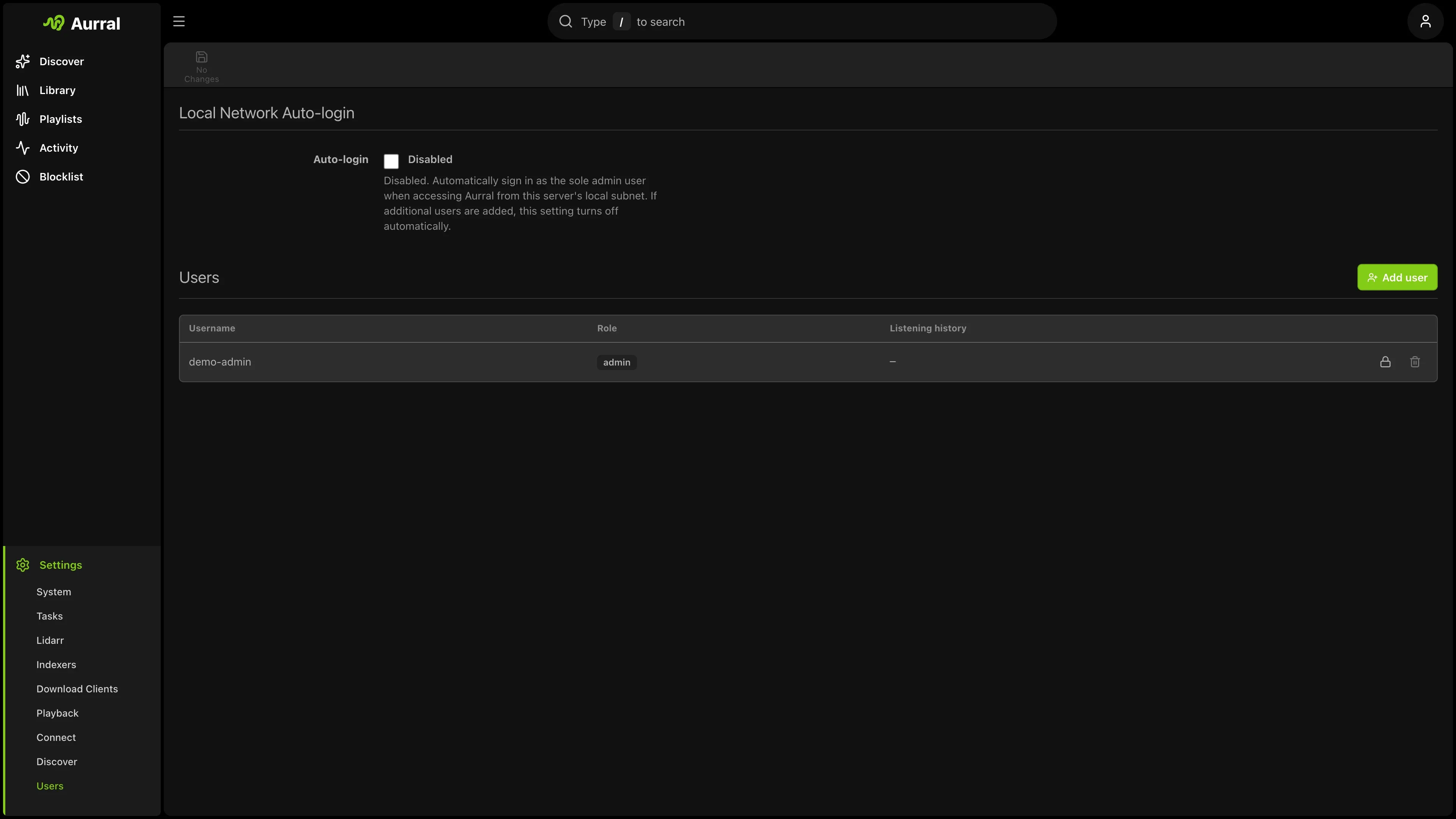
Permissions
Section titled “Permissions”Admins can control whether users can:
- Access playlists and flows
- Add artists or albums
- Change monitoring
- Delete artists or albums
Authentication
Section titled “Authentication”- Local username and password accounts
- Optional local-network auto-login for single-admin home setups
- Reverse-proxy authentication for SSO
- Native OpenID Connect login
Native OIDC
Section titled “Native OIDC”Set OIDC_ENABLED=true and configure your identity provider as a confidential OIDC client.
Required variables:
OIDC_ISSUER- discovery issuer URLOIDC_CLIENT_IDOIDC_CLIENT_SECRETOIDC_REDIRECT_URI- must be exactlyhttps://aurral.example.com/sso/callback
Optional role mapping:
OIDC_DEFAULT_ROLE-user(default) oradminOIDC_ADMIN_USERS- exact usernames promoted to admin at loginOIDC_GROUPS_CLAIM- ID-token claim with group membershipOIDC_ADMIN_GROUPS- groups from that claim that grant admin
Aurral starts login at /api/auth/oidc/login, handles the IdP return at /sso/callback, then issues a normal Aurral session. Username comes from OIDC_USERNAME_CLAIM (default preferred_username), with a fallback to email.
OIDC-created users cannot use local password login until an admin sets a password. Role changes from the IdP apply on the next OIDC login.
Set OIDC_LOGOUT_URL if you want Log out to end the identity-provider session as well.
Native OIDC and reverse-proxy auth can both stay configured. Use one as the primary browser login path for a given deployment.
Reverse-proxy auth
Section titled “Reverse-proxy auth”Set AUTH_PROXY_ENABLED=true to use reverse-proxy authentication. Use AUTH_PROXY_HEADER if the proxy uses a custom header.
The default username header is x-forwarded-user.
When a proxied username first reaches Aurral, Aurral creates a matching local user. The user role comes from one of these sources:
AUTH_PROXY_DEFAULT_ROLE- the default for anyone not otherwise granted admin- An exact match in
AUTH_PROXY_ADMIN_USERS - Group membership from
AUTH_PROXY_ROLE_HEADER(for example, Authelia’sRemote-Groups), compared withAUTH_PROXY_ADMIN_GROUPS
Aurral evaluates the role on every request. A proxy or identity-provider role change takes effect on the next request. You do not have to edit the account in Aurral.
Set AUTH_PROXY_TRUSTED_IPS to your reverse proxy’s address. Without it, Aurral accepts identity headers from any client that can reach Aurral.
On the first request that your proxy authenticates, Aurral issues its own session and the browser uses it for later API calls. Use SESSION_EXPIRY_HOURS to change how long an Aurral session lasts.
Most setups also protect /api with the proxy, so the proxy still decides every request. Page loads always go to the network rather than to Aurral’s offline cache, so your proxy can redirect them to the identity provider whenever its session has ended.
A tab that is already open has no page load to redirect. When the proxy rejects one of its API calls, Aurral reloads that tab, which sends it back through the proxy. Aurral reloads at most once every 30 seconds, so a misconfigured proxy cannot cause a redirect loop.
When the proxy protects only page loads and leaves /api to Aurral’s own session, the open page keeps working after the identity-provider session ends, until the Aurral session expires.
For Authentik, route /outpost.goauthentik.io directly to the Authentik outpost.
Do not protect that location with auth_request. Verify the route before you test Aurral:
curl -i https://aurral.example.com/outpost.goauthentik.io/pingThe response must be 204.
Set AUTH_PROXY_LOGOUT_URL=https://aurral.example.com/outpost.goauthentik.io/sign_out to end the Authentik session when you log out.
Aurral hides its Log out control while proxy authentication is on and this variable is unset, because clearing an Aurral session cannot end the proxy session. Set the variable to get the control back.
Proxy-created users cannot use local password login until an admin sets a password. After creation, admins can manage the account from Settings > Users.
Per-user Plex accounts
Section titled “Per-user Plex accounts”Each user can link their own flow and shared playlists to their own Plex account instead of the shared admin Plex connection. From a user’s Manage dialog in Settings > Users, admins link a Plex Home managed user; anyone can also self-link their own invited/friend Plex account from their Profile page. See Plex - Per-user Plex accounts for the full setup steps.
Reset admin password
Section titled “Reset admin password”From the repository root:
npm run auth:reset-admin-password -- --password "new-password"Generate a random password:
npm run auth:reset-admin-password -- --generate